
Limestone County Court Records After Arrest
After a Limestone County arrest, the jail record and the court record are separate tracks. The jail booking record documents custody, intake, arrest charges, holds, and bond information if it is available. The court record documents the formal prosecution once a complaint, information, or indictment is filed. District Attorney and County Attorney materials name Jeff Janes as the local prosecutor contact in the county office pages, while misdemeanor and felony filing routes depend on the court level and case type.
The distinction matters because Limestone County does not publish an online jail roster that can be compared against a court case screen. For custody or booking detail, use the Limestone County jail inmate records route. For booking photos, use the Limestone County jail mugshots route. For court records after a jail arrest, use the County Clerk, District Clerk, iDocket, the district payment search, and the court that has the filed case.
County records and case search start with the county's own clerk pages. The Limestone County Clerk page identifies misdemeanor records, iDocket participation, criminal records from 1985 to present, and older official public records through CountyFusion.
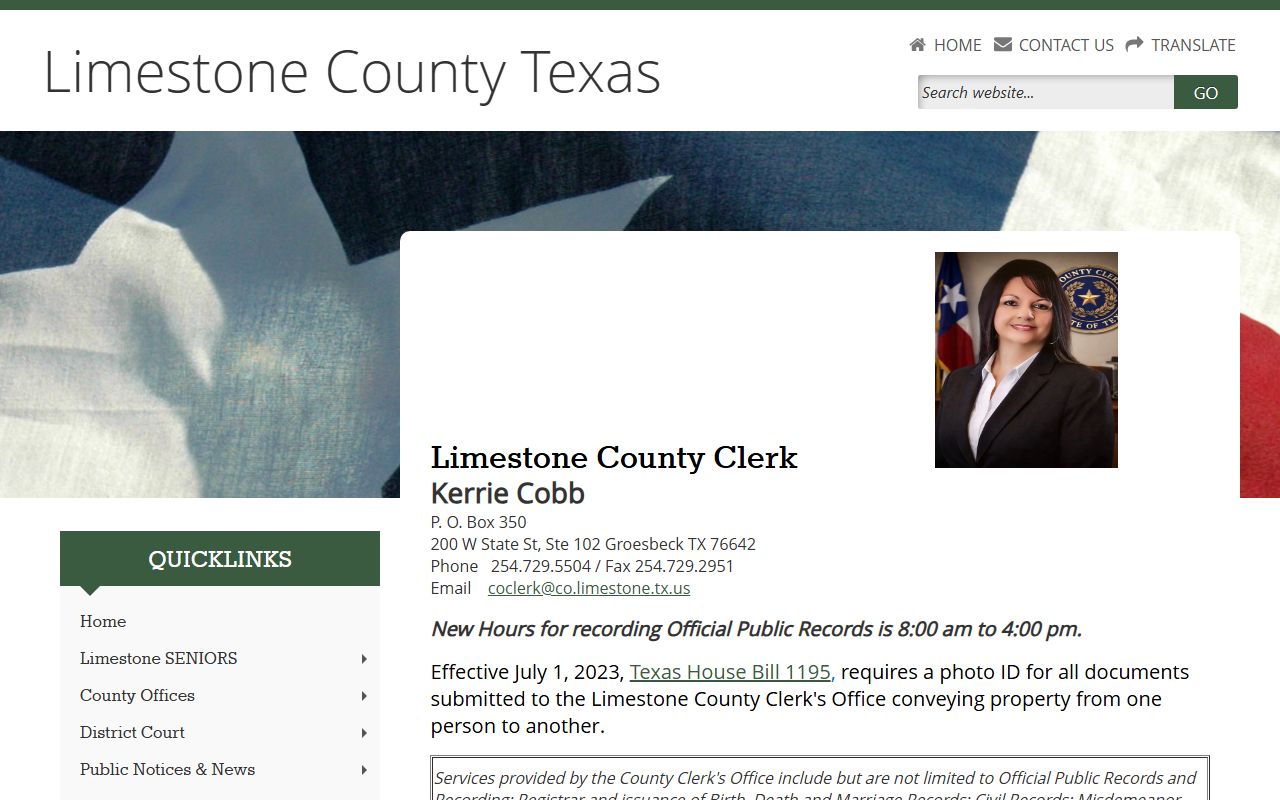
The County Clerk screen is relevant for misdemeanor and County Court records, not for confirming whether a person is still housed in the jail.
Find Limestone County Court Records
The best Limestone County court records after arrest search starts with case level. County Clerk Kerrie Cobb handles misdemeanor criminal records, County Court matters, probate, civil, and official public records at 200 W State Street, Suite 102, Groesbeck. District Clerk Carol Jenkins handles district court records at Suite 206. The County Clerk page says Limestone uses iDocket for court information, while the District Clerk page links a district criminal payment search.
- Confirm the person was booked or released through the jail phone or VINELink if current custody is the first question.
- For misdemeanors and County Court matters, search iDocket or contact the County Clerk with the defendant name, date of birth if known, and possible filing date.
- For felonies and district matters, search iDocket, check the District Clerk payment portal where applicable, or contact the District Clerk.
- Use the cause number when known. If it is not known, search by defendant name and date of birth where the portal allows.
- Compare the filed court charges with the booking or arrest information. The court charge controls case status, settings, disposition, and sentence.
A new arrest may not appear as a court record right away. Booking can happen first, then police reports move to prosecutors, then a charge is filed. If no case appears, the person may still be in intake, the charge may not have been filed yet, or the case may belong to a different court, city, county, state, federal, or immigration channel.
Limestone County Record Search Fields
Limestone County has two useful case-search field sets in the research. iDocket describes broader court case search options for registered users, and the District Clerk payment search exposes a narrower payment-facing search. Neither tool is a jail roster. Their purpose is court records after arrest, payment, or case information once a case exists.
| Portal | Search Field | Use | Limit |
|---|---|---|---|
| iDocket | Plaintiff or defendant name | Find cases by party name. | Full use may require registration or subscription. |
| iDocket | File date | Narrow a recent arrest if a filing date is known. | Features vary by account or plan. |
| iDocket | County or court | Choose Limestone County court or district court where available. | Must choose the right court level. |
| iDocket | State or cause number | Strong search method when a case number is known. | Does not confirm custody status. |
| District Clerk payment search | Case number | Find a district criminal payment or violation record. | Not a full court-file viewer. |
| District Clerk payment search | First name, last name, DOB | Search when the case number is unknown. | Payment record display may be limited. |
| District Clerk payment search | Business name | Search applicable business records. | Not a custody or booking search. |
The District Clerk payment search page shows the real local fields for case number, name, date of birth, and business name.
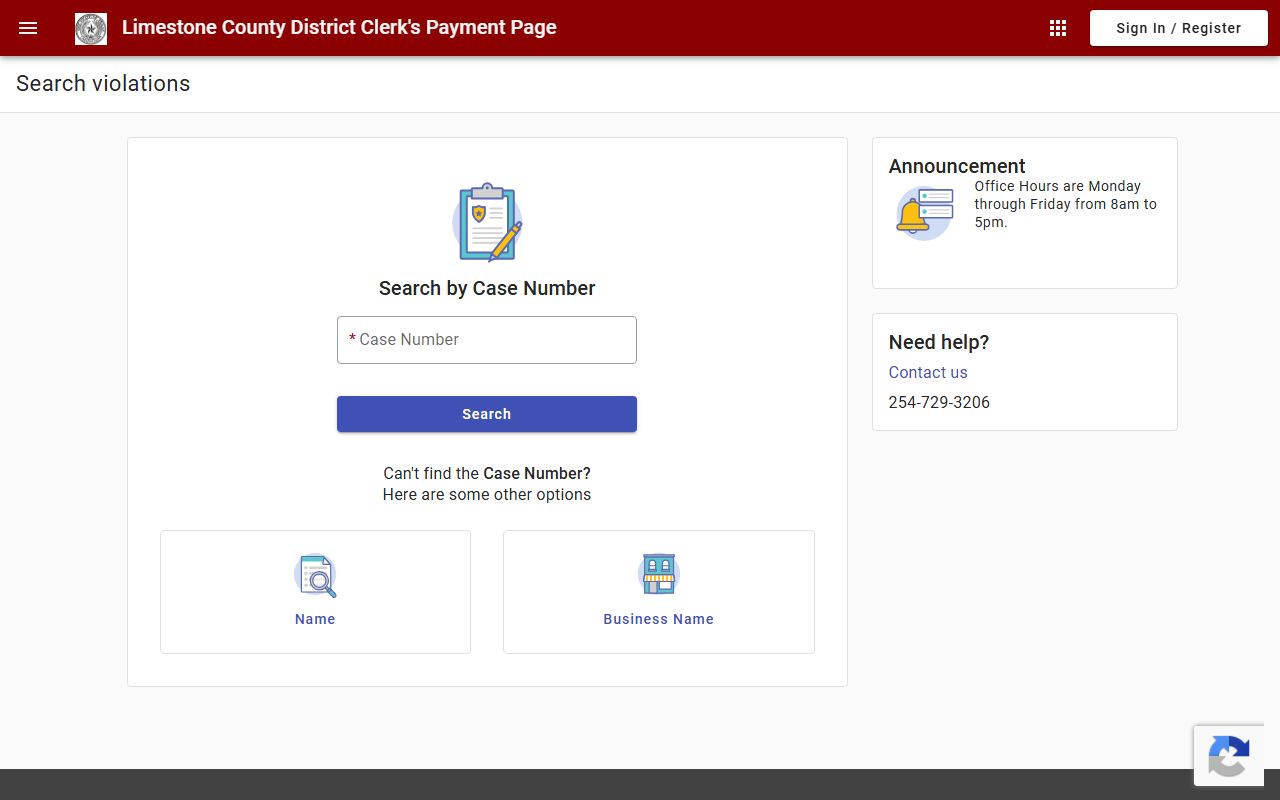
Those fields can help locate a district case or payment record, but they should not be used as proof that a person is or is not in jail.
Limestone County Arrest Charging Documents
Formal court records after a jail arrest usually begin with a charging document. The booking label may come from an arrest warrant, officer paperwork, or initial jail entry. The court charge comes after review and filing. Prosecutors can change the level, add counts, drop counts, or pursue a different offense than the booking label. That is why the court file, not the intake label, is the source for case status.
| Document | Who Files or Issues It | Common Role | Limestone Search Route |
|---|---|---|---|
| Complaint | Officer, complainant, or prosecutor depending on case stage | Early accusation or misdemeanor/probable-cause filing. | County Clerk, District Clerk, iDocket, or court contact depending on case level. |
| Information | Prosecutor | Prosecutor-filed charging instrument used for many non-indictment cases. | County or district court record after filing. |
| Indictment | Grand jury | Formal grand-jury accusation, often for felony prosecution. | District Clerk and district court channels. |
For Limestone County court records after arrest, the practical question is not just what the person was arrested for. It is what the prosecutor filed, what court accepted the filing, and what status the court later entered for each count.
Limestone County Arrest Charge Status
Charge status terms describe where the court record stands. A pending charge is unresolved. An amended charge has changed from an earlier version. A reduced charge is filed or resolved at a lower offense level. A dismissed charge has ended without a conviction on that count. Nolle prosequi, where used, means the prosecutor declined to pursue the charge. An arrest is not a conviction.
| Status | What It Means | Search Tip |
|---|---|---|
| Pending | The court case or charge remains open. | Check future settings and bond conditions. |
| Amended | The filed charge changed after review or court action. | Compare the amended count with the original booking label. |
| Reduced | The offense level or charge was lowered. | Look for plea, amendment, or prosecutor filing notes. |
| Dismissed | The court or prosecutor ended that charge without conviction on that count. | Check whether other counts remain pending. |
| Nolle prosequi | The prosecutor chose not to proceed with that charge. | Review the court entry and date. |
| Convicted | Guilt was adjudicated or a plea was accepted and judgment entered. | Use disposition and sentence fields, not arrest labels. |
Limestone County Arrest Bond Records
Texas bond rules come from Texas Code of Criminal Procedure Chapter 17. Limestone County sheriff pages reviewed did not publish a bond desk page, online bond portal, accepted payment methods, bondsman list, or after-hours bond posting instructions. The local step is to call the jail or relevant court before attempting payment, especially if a warrant, parole hold, ICE detainer, TDCJ transfer status, or another agency hold might block release.
| Bond Type | How It Works | Limestone-Specific Note |
|---|---|---|
| Cash bond | Full amount is paid to secure appearance. | Accepted location and payment type were not posted by the sheriff. |
| Surety bond | A licensed bail bond company posts bond for a fee. | No local bondsman list was found on sheriff pages. |
| Personal or PR bond | Release is based on a promise to appear, often with conditions. | Set by a magistrate or court, not by an online jail roster. |
| Property bond | Property is pledged as security where allowed. | Local procedure was not posted. |
| No-bond hold | Release is not available on that hold until a court changes it. | May involve warrants, parole, another county, federal, ICE, or court order. |
Bond information can change after the first court appearance or after prosecutors file formal charges. If the person is already in a court record, check the correct clerk. County Clerk records handle many misdemeanor and county matters. District Clerk records handle district and felony matters.
Limestone County Warrant Court Records
No official Limestone County sheriff active-warrant search page, public warrant list, or most-wanted roster was located on the county or sheriff sites. A warrant can still lead to a jail booking and then a court record after arrest. Public routing depends on who issued the warrant. A bench warrant may belong with the court. A municipal warrant may require a city court or police contact. A state or county criminal warrant may require sheriff or court contact.
Texas Code of Criminal Procedure Article 15.26 makes the affidavit supporting an executed arrest warrant public information unless an exception applies. That rule does not create a Limestone online warrant search. It gives a public-record framework after execution, subject to limits. A person who believes a warrant exists should use counsel, the issuing court, or the sheriff rather than relying on an absent public list.
Limestone County Charges vs Convictions
Limestone County court records after a jail arrest may show an accusation long before a conviction exists. A charge says the state has filed or is pursuing an allegation. A conviction means guilt has been adjudicated or a plea has been accepted and judgment entered. Search results, booking records, and court records should not be read as the same thing.
| Point | Charge | Conviction |
|---|---|---|
| Stage | Accusation or filed count after arrest. | Final or accepted guilt finding on a count. |
| Proof level | Can begin from probable cause and prosecutor filing. | Requires plea, verdict, or court judgment. |
| Can change? | Yes. It may be amended, reduced, added, or dismissed. | Can be appealed, modified, or later affected by record-clearing law in limited cases. |
| Search use | Use for pending case tracking. | Use for disposition, sentence, and final criminal-history context. |
Limestone County Sealed Arrest Records
Texas record clearing is not automatic just because a person was released from Limestone County Jail. Texas Code of Criminal Procedure Chapter 55 governs expunction, which is the court process for clearing qualifying arrest records. Nondisclosure is different. It can limit public disclosure of some records, but it does not always erase the record or block every government use.
| Point | Sealed or Nondisclosed | Expunged |
|---|---|---|
| Public visibility | Limited from many public searches when an order applies. | Treated as removed or destroyed for qualifying records under the order. |
| Government access | Some agencies may still have limited access depending on law. | Access is much more restricted, but the order controls scope. |
| Eligibility | Depends on Texas nondisclosure law and case outcome. | Depends on Chapter 55 and the exact arrest, charge, and disposition. |
| Where to start | Review the court record and seek legal advice if needed. | File through the court process that applies to the arrest record. |
Note: A dismissal entry is not the same thing as an expunction order, and old search results may not update until the correct court order exists.
Restricted Limestone County Court Records
Texas public access law begins with Texas Government Code Chapter 552, but several limits can affect Limestone County court records after an arrest. Active law-enforcement records may be withheld under Section 552.108 in some situations. Juvenile records, sealed records, expunged records, protected victim information, medical or mental-health details, and some privacy-protected material may also be closed, redacted, or handled through a different process.
Important: Public court lookups are not consumer reports and should not be used for credit, employment, tenant screening, insurance, or other FCRA-covered decisions.